Q and A on AI: a bloodbath?

How is the stock market on-off love affair with artificial intelligence going to play out? Will there be a market bloodbath? My colleague Alan Bartlett and I gave our thoughts in a recent event at a big fund management event in Germany. You can read the transcript by following this link. Here are a couple of short extracts, detailing the arms race between OpenAI and Anthropic:

Q: You have developed a five-phase model for investment booms. Are we already through the prototype phase?

Nairn: I think we are way past the prototype. We are already in the deployment phase. And the most pressing issue for financial markets is that companies like OpenAI or Anthropic really do not have much by way of revenues. Their revenues are in the billions, but their costs are in the tens of billions in terms of compute power. So they need to either raise capital to pay for all these data centers, or they are in trouble.

Five Phases of a Boom: The Dynamics of Technology
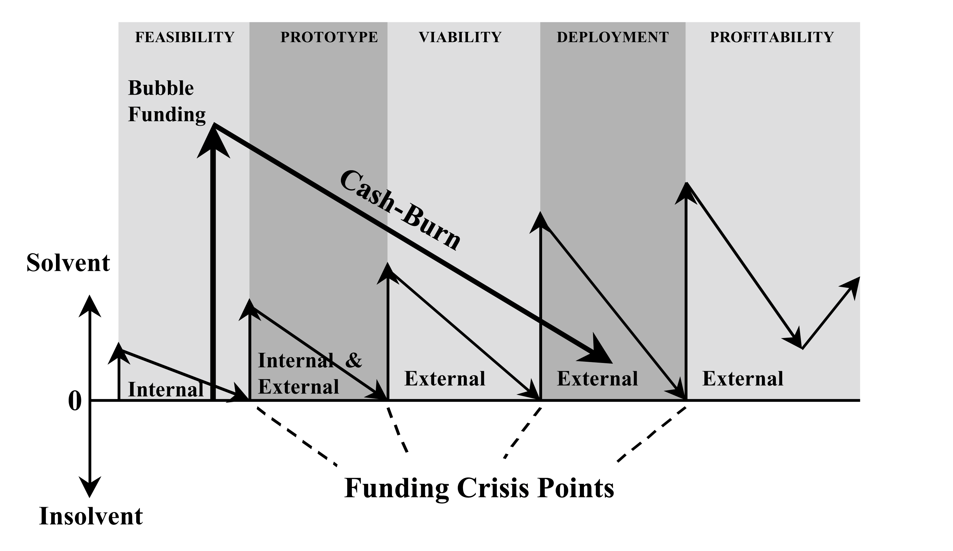
Source: Alasdair «Sandy» Nairn, «Engines That Move Markets», p. 502.

What will cause the financing crisis for AI companies that you expect?

Nairn: Sales will not increase fast enough. Only 5% of OpenAI users pay subscription fees. That’s why Anthropic and OpenAI are always raising new capital and are preparing IPOs……The question is where OpenAI and Anthropic can generate sufficient revenue. From my point of view, only advertising can generate sufficient revenues to cover their costs. But this is more difficult than it was for the internet companies.

Q. Why is that?

Nairn: Because the internet companies did not have competition online. Google basically got 90% of search online advertising revenues, and achieved profitability after three years. But if OpenAI wants to get online advertising revenues, it has to take them from Google. That’s a very different battle. OpenAI and Anthropic have to get into competition for advertising revenues. That is going to be a bloody battle, because Google is at the forefront of all of these technologies and it cannot afford to lose. I don’t know how long this battle will last.

Other topics covered include:

Long term winners and losers; AI’s impact on the professions; small language models and the over-valuation of the US stock market. This is the biggest topic of the day for financial markets.


AI unpicked – my new book

Artificial intelligence is the latest technological advance to send the stock market into a frenzy, but how significant is it? And how will it all play out for investors?

These are the questions which my new book, due out this year, sets to answer. Building on the analysis that underpinned my earlier book, Engines That Move Markets, and based on two years of intensive research and discussion with AI pioneers, the book puts the current excitement into context and maps out how AI will change the world of work and who the likely winners and losers will be.

I shall be releasing segments of the ten chapter book in advance of final publication, covering everything from the history of AI, the reasons it is taking off now, what it can do and who will win the race to dominate this brave new world. While there are already many books about AI out there, this is the first to be researched and written by a full time professional investor who has studied the market impact of all the biggest technological changes of the last two hundred years, from the canals and railways onwards.

Understanding the meaning of AI and its potential impact is the most important issue facing any investor today, as we all try to navigate our way through this transformative moment for society. This is my take on how it will all play out. Signing up as a follower of this site will enable you to read the extracts as they come out ahead of the formal publication of the final version later in the year.

Understanding AI

Artificial Intelligence has been dominating the media and investment landscape for months as tools such as ChatGPT introduce AI’s capabilities to the general public. The press coverage ranges from the apocalyptic (“end of the world”) to the messianic (a coming productivity and innovation miracle which will save the world). Capital has certainly been flowing to AI, with private investment estimated at approximately $120bn last year, with the US accounting for about two thirds of the total, while Nvidia and other listed companies have dominated the performance of leading public market indices.

However, when one meets with corporates or reads most of the press, what is striking is the lack of precision in the discussion. AI is commonly referred to in generic terms, despite it being both multi-faceted and at various stages of development, depending upon which facet one is referring to. This is normal for an emergent technology but to understand the potential ramifications much more granularity is required.

As a starting point, it is helpful to spend some time with people who are at the leading edge of recent developments and try to explore some of the obvious questions with them. In 2022 a team from Glasgow University won the prestigious Amazon Alexa Prize Taskbot Challenge and have since recently launched Malted AI, a new company that aims to develop AI for the corporate sector, in which I have invested. Follow this link to read my Q and A with them about the potential and challenges of this exciting but not clearly understood technology.

UK election special podcast

The UK goes to the polls on July 4th 2024, with the current Labour opposition party expected to win a comfortable majority and propel them into government for the first time since 2010. What are the challenges and opportunities that this change of regime creates – and how effective is the new administration likely to be, given the lack of fiscal headroom after several years of crises and rising government debt levels? What will be Sir Keir Starmer’s priorities?

I discuss these important issues with an expert and (crucially) politically independent panel in the latest edition of the popular Money Makers podcast, hosted by Jonathan Davis. You can listen in to this high level 40 minutes conversation by following this link. The other speakers are Nick Macpherson, former permanent secretary at the Treasury from 2005 to 2016, and Ed Balls, journalist, broadcaster and former MP and government minister.

Trouble postponed: the outlook now

Global Opportunities Trust, the investment trust of which I am the Executive Director, published its latest annual results on April 10th 2024, revealing a modest 1.7% Net Asset Value total return for the twelve months ending 31st December 2023. You can read the announcement here and download the Annual Report from the trust’s website, together with my assessment of the outlook. While it is evident that global equity markets remained more resilient than I expected over the course of 2023, the fundamental factors that underpin and explain the cautious positioning and strategy of the trust remain unchanged.

“Rather than a rosy economic environment ahead ” I conclude “the storm clouds look to be gathering. Sovereign bond prices may not suffer too much from here, but one has to expect credit spreads to widen and for equities eventually to react to an environment in which profit progression becomes increasingly difficult. Policymakers should be aware also of the tail risk of sovereign credit risk becoming a theme the vulture funds can latch onto. The deterioration in Germany’s economic position is particularly worthy of note”. The AGM of the company is on May 16th in Edinburgh.

Analysis: Recession or no recession?

Market participants remain divided whether the US and global economies can avoid a recession. In this latest analysis piece, I examine the evidence on both sides of the argument and conclude that, despite welcome resilience to date, there is little realistic chance that a recession can be avoided, with inevitable further consequences for asset prices. The complacent assumption that, if economic conditions deteriorate, there will still be a return to free money remains prevalent in many quarters. The return of inflation and rising interest rates, in other words, have not so far punctured “the everything bubble” completely. You can download the article as a pdf here, or follow this link http://www.globalopportunitiestrust.com/recession-no-recession/

Analysis: An opera of canaries

Although they have been treated by many market participants as isolated and unrelated shocks, three recent episodes – the collapse of the cryptocurrency exchange FTX, the failure of Silicon Valley Bank and the UK pension fund crisis in autumn 2022 – should more realistically be seen as accidents waiting to happen and harbingers of more market disruption to come – what I call “canaries in the mine”. In this latest article I explain what binds these three episodes together and why they won’t be the last such disruptive events investors will face before the “Everything Bubble” finally deflates. The collective noun for canaries is an opera, hence the title. This is the link to the article.