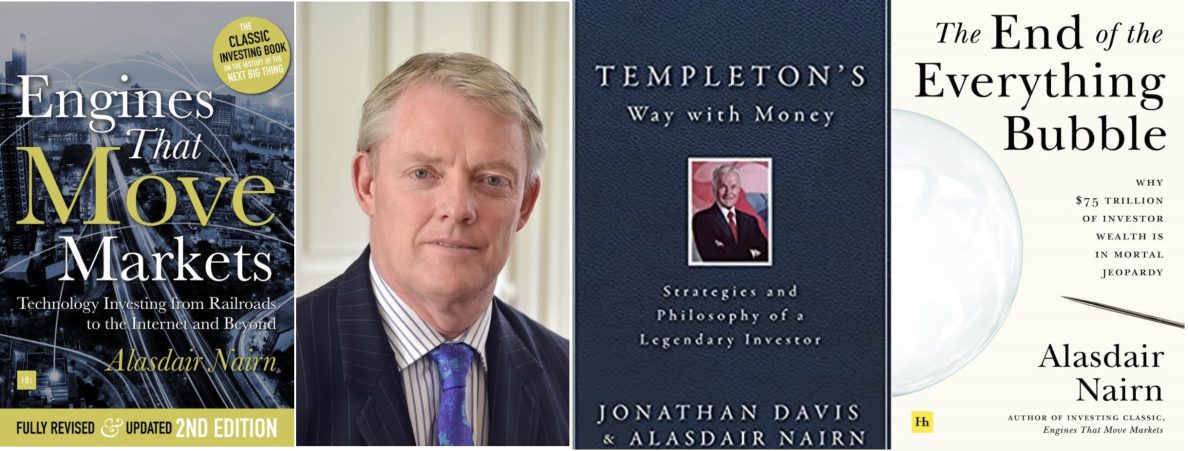
These are the four full length books that I have written. You can order copies from the publishers or from Amazon and other online book retailers. My next book is a follow up to the first, How Engines Move Markets, and brings the same analytical framework to investigate the likely impact of Artificial Intelligence on financial markets.
How AI Will Move Markets
My latest book, to be published in December 2026, builds on the analysis that underpinned my earlier book, Engines That Move Markets. It is based on three years of intensive research and discussion with the pioneers behind AI’s explosive growth and places the current excitement into context and maps out how AI will change the world of work, its impact on financial markets, and who the likely winners and losers from its adoption will be.
While there are already many books about AI out there, this is the first to be researched and written by a professional investor who has studied the market impact of all the biggest technological changes of the last two hundred years, from the canals and railways onwards. Understanding the meaning of AI and its potential impact is the most important issue facing any investor today, as we all try to navigate our way through this transformative moment for society. This is my take on how it will all play out.
How AI Will Move Markets “is the book I wish every investor would read before making a single AI decision. What makes it different from the shelf of AI books already out there is simple: it is written by a professional investor who has studied two hundred years of technological change, not by a futurist guessing about the next two. He treats AI exactly as it deserves to be treated – as the latest chapter in a very long book”. Philippe Laffont, Founder, Coatue Management.
The End of the Everything Bubble
The period since the global financial crisis has seen an unprecedented change in the way that central bankers and governments have behaved. By holding down interest rates for so long, central banks have helped to create one of the great bubbles in investing history, as well as enabling an extraordinary build up in the level of debt held by governments, companies and individuals. As I explain, this was always bound to end in an almighty collapse in the value of all types of financial assets. This is now taking place. The book chronicles the stages by which the bubble inflated and the likely consequences.
“Take a tour through Sandy Nairn’s well-curated well financial picture gallery. The images should frighten you…….A timely warning by an investor who knows whereof he speaks”. James Grant, Editor, Grant’s Interest Rate Observer.
Templeton’s Way With Money
This book, co-authored with the professional investor and financial writer Jonathan Davis, examines the life and investment philosophy of one of the greatest investors of the modern era. Sir John Templeton (1912 to 2008) was a lifelong investor in the stock market, as well as a notable philanthropist. Over the course of his long career as a professional investor, he produced exceptional returns for his wealth management clients and for investors in the Templeton Growth Fund. His philosophy and investment approach remain as valid today as they were during his lifetime. The book draws on letters and memos that Sir John wrote to his clients as well as on my own experience working for him in the 1990s.
“A simply great new contribution about a beyond great market phenomenon. Any investor, young amateur or fifty-year professional will benefit to be sure. A lot of wisdom here for non-investors too”. Ken Fisher, Founder and CEO, Fisher Investments.
Engines That Move Markets
This was my first book and chronicles the extraordinary way in which the stock market has repeatedly witnessed speculative booms and busts driven by the emergence of new and life-changing technologies, from the railways onwards. I wrote it in the aftermath of the Internet bubble of 1999-2000, in part to try and understand how investors could have come to behave in such an extraordinarily irrational way, assigning huge valuations to start up companies that had no profits (and in some cases no revenues). It was a speculative mania to rival the famous bubbles of the past. By comparing this episode with those of the similar episodes in the past I sought to draw conclusions about the conditions which are needed to create this kind of bubble and the likely fallout that will occur when they finally burst.
“An outstanding book – a must read for all serious investors and for anyone interested in technology”. Professor Paul Marsh, Emeritus Professor of Finance at London Business School.

